

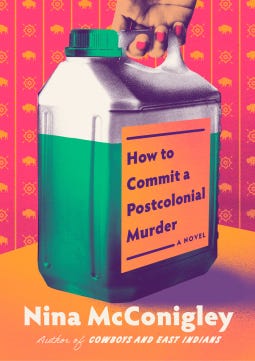
How to Commit a Postcolonial Murder by Nina McConigley
Published: January 20, 2026 by Pantheon
Buy this book: Bookshop.org
Note: Buying this book through the affiliate link provides me a small commission at no extra cost to you. Thanks for your support!
Synopsis:
Summer, 1986. The Creel sisters, Georgie Ayyar and Agatha Krishna, welcome their aunt, uncle and young cousin—newly arrived from India—into their house in rural Wyoming where they’ll all live together. Because this is what families do. That is, until the sisters decide that it’s time for their uncle to die.
According to Georgie, the British are to blame. And to understand why, you need to hear her story. She details the violence hiding in their house and history, her once-unshakeable bond with Agatha Krishna, and her understanding of herself as an Indian-American in the heart of the West. Her account is, at every turn, cheeky, unflinching, and infectiously inflected with the trappings of teendom, including the magazine quizzes that help her make sense of her life. At its heart, the tale she weaves is:
a) a vivid portrait of an extended family
b) a moving story of sisterhood
c) a playful ode to the 80s
d) a murder mystery (of sorts)
e) an unexpected and unwaveringly powerful meditation on history and language,
trauma and healing, and the meaning of independence
Or maybe it’s really:
f) all of the above.
Rating:

Review:
Let me start by saying that the primary theme of this book is the exploitation and commodification of brown bodies. It offers a dark account of some of the most horrifying experiences faced by those who inhabit them. The subject matter is heavy and unflinching: racism, CSA, sexual assault, internalized racism, and abuse. If these topics are triggering for you, this may not be the book to pick up.
I found the novel as depressing as it was riveting. The author is a vivid, descriptive writer, and the darker elements are delivered with a gut-wrenching bluntness. For those reasons, I really wanted to love this book. But there were several elements that felt out of place. The teen magazine quizzes, for example, were distracting. I understand they were meant to add a layer of humor or irony, but I found them jarring rather than effective.
There are also a lot of tangents. By the end, it felt like I’d been given thousands of fragments rather than a fully realized story. Georgie has a strong, distinct voice, but I wish it had come through more clearly beneath the meandering structure of the narrative. The book touches on racism, abuse, CSA, bullying, Indian history, sisterhood, and more. It’s a lot for one novel to carry.
Overall, this is a book I desperately wanted to love but ultimately felt disappointed by. It’s not a bad book—it just wasn’t quite what I expected.
sorry it wasn’t for you - but thank you for reading