

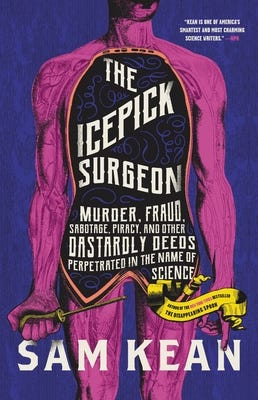
The Icepick Surgeon: Murder, Fraud, Sabotage, Piracy, and Other Dastardly Deed Perpetuated in the Name of Science by Sam Kean
Published: July 13, 2021 by Little, Brown and Company
Buy this book: Bookshop.org
Disclaimer: Purchasing the book through this link provides me a small commission at no extra cost to you. Thank you for the support!
Synopsis:
Science is a force for good in the world—at least usually. But sometimes, when obsession gets the better of scientists, they twist a noble pursuit into something sinister. Under this spell, knowledge isn’t everything, it’s the only thing—no matter the cost. Bestselling author Sam Kean tells the true story of what happens when unfettered ambition pushes otherwise rational men and women to cross the line in the name of science, trampling ethical boundaries and often committing crimes in the process.
The Icepick Surgeon masterfully guides the reader across two thousand years of history, beginning with Cleopatra’s dark deeds in ancient Egypt. The book reveals the origins of much of modern science in the transatlantic slave trade of the 1700s, as well as Thomas Edison’s mercenary support of the electric chair and the warped logic of the spies who infiltrated the Manhattan Project. But the sins of science aren’t all safely buried in the past. Many of them, Kean reminds us, still affect us today. We can draw direct lines from the medical abuses of Tuskegee and Nazi Germany to current vaccine hesitancy, and connect icepick lobotomies from the 1950s to the contemporary failings of mental-health care. Kean even takes us into the future, when advanced computers and genetic engineering could unleash whole new ways to do one another wrong.
Rating:

Review:
This book caught my eye a few years ago and I purchased it for myself but just never got around to reading it. The premise was interesting to me and while some of the content was rather predictable, I found a lot of great content here. For example, how can you write a book about science gone wrong without talking about Nazi experimentation on concentration camp victims? So, some of this was expected content but other things I was unfamiliar with.
I enjoyed that he split up the book into sections of specific time periods or wrongs. For example, consorting with pirates in order to travel to distant reaches of the world for scientific exploration was a practice that happened for a long time. So, we get a whole section that mentions notable names.
This naturally flows into, now that the scientists are in these distant reaches of the world and the pirates have moved on….how does one get home? By hoping on board the slave trade boats of course! I was both surprised and unsurprised how some of these things intersected. Surprised because I didn’t know about it, but unsurprised because it seems like a natural progression given travel options at the time. But, a lot of the stories covered are not as innocent as taking advantage of an existing atrocity for a scientific gain, but opening harming people in the name of scientific gain. In my mind, those are distinct classifications and I was glad to see the entire range represented at various points in the book.
A few big frustrations that I had with the book is the lack of compassionate phrasing in parts of the book. It’s not unusual for Kean to call indigenous people “Indians” within his own commentary. When we’re quoting from official documents or sources, fair enough, you should not change that wording to be more sensitive. But, when we’re describing events or adding commentary on those events, a bit more care should have been taken. I also got really annoyed at the author’s constant plug for his podcast. At least 10% of the footnotes in this book reference you back to his podcast. We get it dude, you have a podcast. This is a compilation book of things you’ve researched related to that. But I am reading the book, I want that information within the covers of the book.
My last frustration is with the inequity in detail of the stories. In some instances a single story will get an entire chapter all to itself. While others get a few brief paragraphs that have virtually no detail. A lot of the tidbits felt pointless to add because we weren’t given enough detail or context. It made the text feel a bit jarring to read.
On the whole this is a good book that presents a lot of cautionary tales about science and hubris. It urges the public to be cautious about what a doctor tells them to do, to use their instincts and be mindful of protecting themselves from bad actors. It also speculates on how advancing technology might impact what kind of future atrocities may be wrought as time goes on. In the end it is the responsibility of the public to police the hubris and overreach of the scientific world. Placing blind faith in people because they are “scientists” can be immensely harmful, as history shows us again and again.